


A Little Piece of Honduras in Huntington Park


At Parrillada con Familia, Hondureños in LA created more than a picnic. Between punta, baleadas, small businesses, flags and kids learning to dance, they created a space for Catrachos—and their Central American neighbors—to see themselves.
It was hot in Huntington Park. Like, why did I decide to wear this today? hot. But that didn't stop Hondureños from showing up. They came wearing Honduras jerseys. Traditional clothing. Blue and white. Flags wrapped around shoulders and raised proudly in the air.
Kids came. Parents came. Small businesses came. DJs came. And somewhere in the middle of Salt Lake Park, a dude was standing over a charcoal grill handing people freshly grilled elotes. Honestly, that's a pretty solid way to be welcomed anywhere.
This was Parrillada con Familia, a free community event organized by Hondureños in LA around a simple idea: bring your bandera, bring your blanket, bring your hammock, bring your family and spend an afternoon celebrating Honduran culture. And that's pretty much what happened.
What interested me wasn't simply that Hondureños showed up. It was seeing what happens when a community intentionally creates a space to show up as themselves.
H for Hermosa 🇭🇳
There was no mistaking where you were. Honduran flags were everywhere. People wore fútbol jerseys, traditional clothing and custom Catracho outfits. There was food, music, dancing, vendors, artists and entrepreneurs.
As they say: H — for hermosa. And there were plenty of beautiful women. Beautiful men too. Beautiful souls. Relax. We're an equal-opportunity publication over here.
Underneath all the fun was something I've increasingly come to appreciate about these community events. Representation doesn't always have to mean seeing yourself on television or getting a giant Hollywood movie. Sometimes representation is as simple as walking into a park and realizing: Oh. This is for us.
There was food
One familiar face was Honduras Kitchen, a restaurant that's become something of an institution for Hondurans in Southern California. The Larios family founded Honduras Kitchen in Huntington Park in 1992, meaning they've now spent more than three decades serving the community. And yes. There were baleadas. But every time I encounter Honduran food, I'm trying to get past the baleada. Not because I don't like them. I do. If you've spent even a little time around Honduran culture in Los Angeles, you probably know what a baleada
is.
What's next?
Tell me about pollo con tajadas. Tell me about sopa de caracol. Tell me about the dish your mom makes. Tell me what you eat when you go home. That's the stuff I'm curious about. One of these days I'm going to properly sit down at Honduras Kitchen and let somebody educate me. Consider that a warning. A little taste of somebody else's childhood.
Another vendor handed me something that initially confused the hell out of me: A malteada. As she explained it to me, I immediately started doing the immigrant-kid translation game. "Ohhhh... so kinda like..." And suddenly we're comparing Honduran childhood treats to Salvadoran charamuscas, Topogigios, licuados and all the little frozen or blended things you grow up eating that are incredibly difficult to explain to somebody who didn't.
Those are some of my favorite conversations. Because Central Americans spend so much time emphasizing the differences between our countries—and trust me, we'll fight over them—but then someone explains a childhood food and you realize: Wait... we had basically the same shit. 😂 Different name. Different preparation. Same feeling.
A marketplace of Catracho culture
Throughout the park were Honduran-owned businesses and vendors selling food, clothing, art and pieces of home. La Pulpería Catracha had a huge spread of Honduran snacks, small artisan goods and cultural items. Artist Jenny V was creating and selling custom pieces—jackets, denim, hats and graffiti-influenced work. There was coffee. There were food vendors. There were entrepreneurs meeting other entrepreneurs. And representatives from the Honduran business community were moving throughout the event, introducing themselves, taking photos and making connections.
That's another part of events like this that can get overlooked. They're celebrations. But they're also infrastructure. Someone discovers a Honduran restaurant. Someone buys from an artist. A business owner meets another business owner. An organization finds a collaborator. A student discovers a community. A photographer meets his next subject. And slowly, those connections become an ecosystem.
Central Americans showing up for Central Americans
Something else stood out to me. It wasn't only Hondureños. There were Salvadorans and other Central Americans there supporting the event, including people working behind the scenes. And then I met students from UCLA's UNICA — Unión Centroamericana de Estudiantes.

That one hit me differently. UNICA describes its mission as empowering Central American students at UCLA by building community and creating a visible student-led Central American movement.
I went to USC. Yes, UCLA people, you may boo now.
When I was in college, I don't remember feeling like there was a space specifically built around being Central Americans. There were broader Latino spaces. There were Chicano spaces. But Centroamericano? I didn't really have that. So seeing college students intentionally organizing around Central American identity—and coming out to community events because they want to learn, document, participate and connect—means something to me.
Things are changing. Slowly. And maybe the generation after us won't have to search quite as hard to find themselves.
Then came the drums
One of my favorite parts of the afternoon was a lesson in Garífuna culture and punta led by Itarala Gamboa. And this is where I learned something. From the outside, people can look at punta and focus almost entirely on the hips and movement. But that's an incomplete picture.
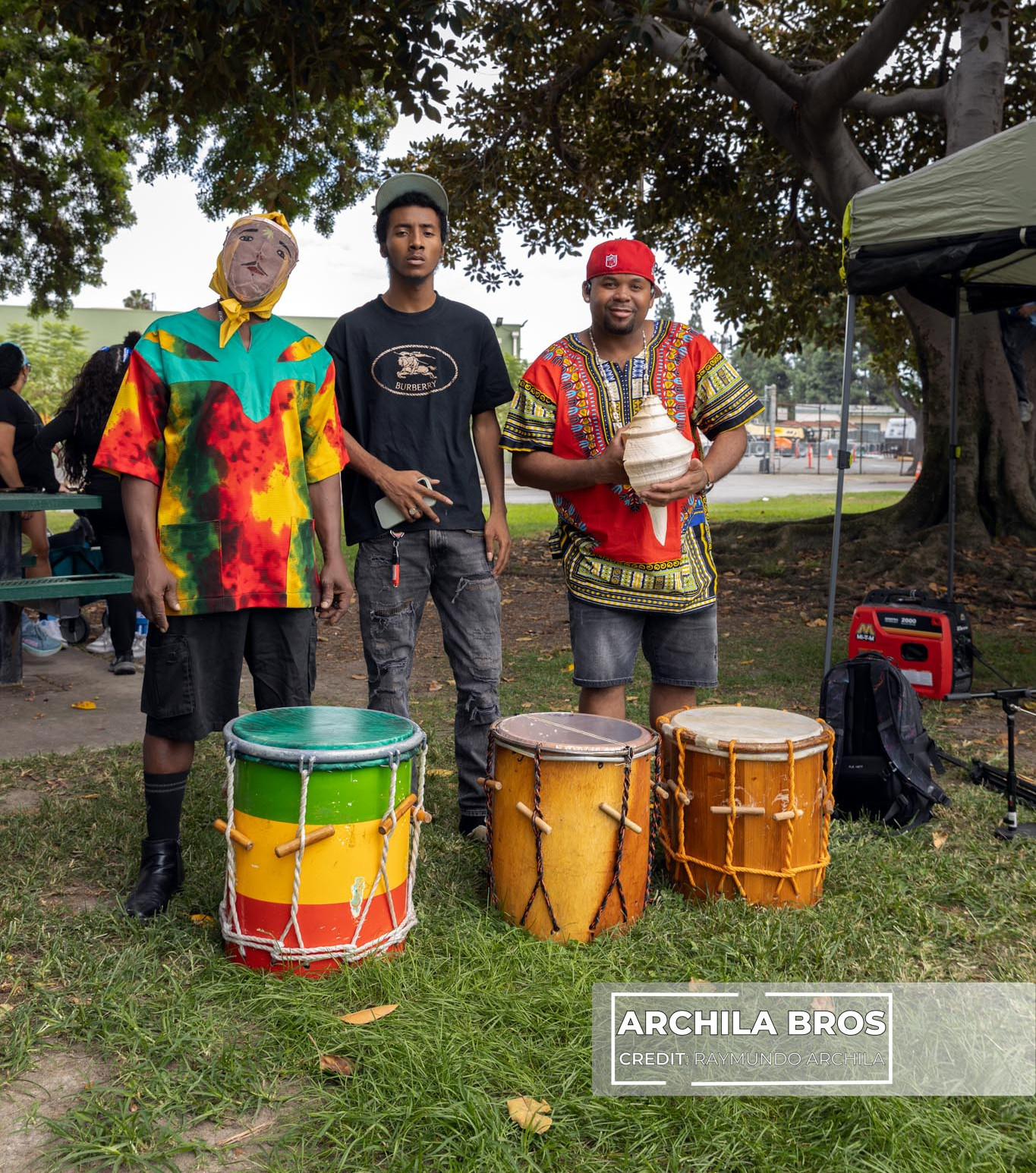
Punta belongs to the much larger world of Garífuna music and dance, a culture extending across Honduras, Belize, Guatemala, Nicaragua, and into diaspora communities like Los Angeles.

Its meanings have changed across time and context. Punta has been associated with wakes and mourning, continuity of life, fertility and courtship, while contemporary forms are also danced at weddings, holidays, parties and other celebrations. The sensuality isn't imaginary. But reducing the tradition to sexuality is the problem. Itarala spoke about dancing as connection—to the music, to spirit and to ancestors. She explained gestures. She talked about what it meant when someone raised their hands.
And then everybody danced.
The kids understood before I did
This might have been my favorite thing to watch. Little kids entered the dance circle. And they just went for it. No overthinking. No: "Do I look stupid?" "Am I doing this correctly?" "Are people watching me?" They danced. Everybody cheered.Another kid went in. People cheered louder. As someone who was terrified to dance as a kid—and, let's be real, occasionally still is as an adult—I loved watching that.
That's how culture survives. Not because somebody hands a child a textbook and says: This is your heritage. Memorize it. But because someone starts playing the drums. An adult shows them the movement. Their family cheers. They laugh. They try again. And somewhere inside that experience, culture becomes associated with joy.
I left too earlyUnfortunately, I made a tactical error. I am punctual. This is apparently a terrible quality to have at a Central American function. I arrived early. Therefore, I left early. And anyone who understands our people already knows what happened next. That's when the party really started.
I missed some of the later Garífuna performances, but looking through the footage afterward, you can see exactly when the energy shifted. The drums came out. People gathered. Bodies started moving. And suddenly the parrillada became something else.
Lesson learned. Next time: Come a little late. Stay a little late. My ancestors are disappointed in me.
Spaces like this matter
It's easy to look at Parrillada con Familia and say: It was a picnic. There was food. People danced. Kids played. Everyone went home. But I think that's underselling it.
Hondureños in LA created a space where Hondurans could publicly celebrate being Honduran. Where a kid could learn punta. Where somebody could discover a Honduran-owned business. Where college students could talk about Central American identity. Where Salvadorans could come support Hondurans. Where someone could wrap themselves in a blue-and-white flag without having to explain what it meant. And where, for a few hours on a very hot Southern California afternoon, a park in Huntington Park could feel like a little piece of somewhere else.
That's worth documenting. Because Cultura isn't only the huge moments. Sometimes it's an elote off a charcoal grill. A fútbol jersey. A grandmother watching a kid dance. A drum. A flag. A food you haven't tasted since childhood. A stranger yelling encouragement when you finally step into the circle.
These are the little things that tell us: You're still connected.
Maybe that's ultimately what organizations like Hondureños in LA are building.
Not simply events.
Places to find one another.
Archila Bros × Cultura Fest
Documenting the people, places and communities shaping Central American culture in real time. And if you're Honduran in Southern California or simply want to experience and support more spaces like this, Hondureños in LA is one to keep on your radar.
Comments